
The Short Tailored Coat, in Black, Beige, and Brown

The Short Tailored Coat, in Black, Beige, and Brown
A short tailored coat is the coat for the woman whose outfit is the point. It ends above the knee, so the dress or the trousers underneath keep doing their work, the belt sits where her waist actually is, and she walks into the room already looking like the version of herself she planned at 7:40 that morning. The Iris short coat from Luna Fashion House does this in three colors: deep black, cream beige, and a brown with a floral pattern woven into the hem. This is the story of when each one is the answer.
She is 39, in a role she earned in March, and her calendar now has evenings in it. The problem is not the dress. The problem is the long coat that swallows the dress between the car and the door, hides the waist she chose that dress for, and takes the whole first minute of the evening to get out of. She has searched for a short coat for women, a cropped coat to wear over a dress, a coat for a petite frame that does not drown it. What she wants is simpler than any of those phrases: a coat that lets her arrive as herself.
Shop the pieces in this story: Winter Coats and Light Coats. Complete size runs are listed first.
Why a short coat changes the evening
In more than 35 years of fittings, the short coat is the one that most often makes a woman stand differently the moment it closes. A long coat asks her to carry it. A short one, cut to end above the knee with the waist marked, gives the shape back to her. The Iris is built for exactly that: a wide collar that stands away from the neck and frames the face, a front zip from the waist to the throat, a belt with a double-ring buckle at the natural waist, and a tiered hem that adds movement at the hip without adding bulk.
The cloth is a soft European cotton blend, 81 percent cotton, 14 percent polyamide, and 5 percent elastane, with a tonal pattern woven through it and a subtle satin finish. The cotton gives it the body of a tailored blazer; the elastane means it recovers its shape after a long dinner in a small chair; the finish catches light in a way flat cloth cannot. It is cut, sewn, and finished in our atelier in Pozarevac, Serbia, where we have made coats since 1990, in small runs of a few of each size, with no reorders mid-season.
The black, for the night the dress is the point
It is a Thursday in late October, 54 degrees at 6 p.m., and the dinner is the one where her new title is said out loud for the first time in front of clients. Under the coat is the Lucy jacquard midi dress in midnight blue, and the reason she chose the Iris short coat in deep black is that the coat stops where the dress begins to flare. The skirt shows. The waist shows. Nothing is hidden on the walk from the car.

She finds the belt by hand without looking down, because the buckle sits at her waist and not an inch below it. The zip closes in one movement from waist to throat, and when the wind comes around the corner of the building she turns the collar up and it holds against her jaw. At the door the coat comes off in the time it takes the host to say her name: no wrestling, no scarf caught in a lapel, no long coat draped over a chair for three hours. Later, in the photograph someone sends her, the black satin finish is what she notices first. It has depth. It does not read as a void the way flat black cloth does under a flash.

The dress that lives under it most often in our fittings is that Lucy: a navy jacquard midi with sheer three-quarter sleeves and a skirt that moves. The coat sits at the natural waist of most midi dresses, so the two read as one decision rather than two.

The beige, for daylight and the days that run long
The same coat in cream beige is for a different day, or for the same woman in April. A garden wedding at two in the afternoon. A client lunch that becomes a walk. A Saturday brunch she wants to look like she dressed for, without looking like she tried. The Iris short coat in beige reads softer than black and warmer than white, and the tonal pattern in the cloth shows more in daylight, so the coat has texture from across a lawn.

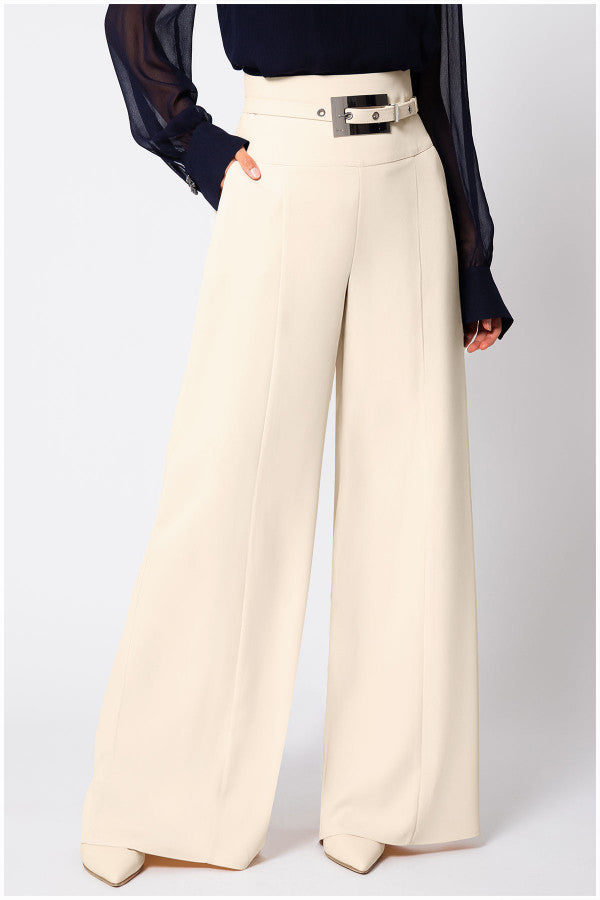
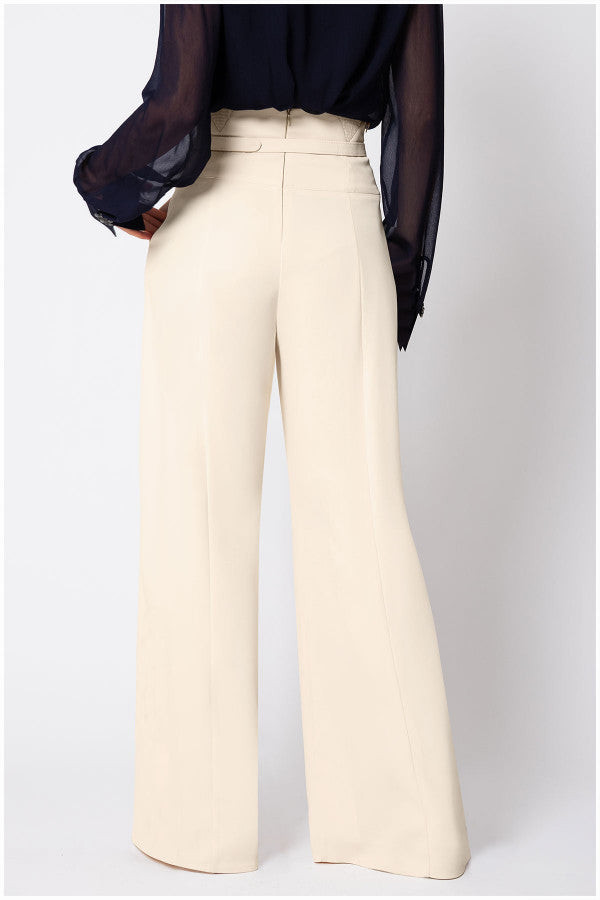
What she wears under it is almost always the Agatha high-waisted wide-leg pants in ivory: the coat ends above the knee, the pants fall clean to the shoe, and the whole line is one soft neutral from collar to hem. The high waist of the pants and the belt of the coat sit at the same height, which is the detail that makes the outfit look planned rather than assembled. Turned cuffs, a slanted pocket at the hip for her phone, and the same double-ring buckle in dark metal against the cream.


The brown, for the closet built on warm tones
Some women dress in black and gray and some women do not. If her closet is cognac, oxblood, taupe, ivory, and warm cream, black is the color she keeps buying and never quite reaching for. For her, the answer is the Iris short coat in brown: the same cut, in a saturated brown with a floral pattern woven into the tiered hem and the cuffs, so the coat has a second register up close that it does not announce from across the street.

Brown is the neutral most women underuse. It reads richer than camel in a photograph and warmer than black against the skin, and on a woman with gray or silver hair it is one of the kindest colors there is. She wears it over the ivory Agatha pants for a restaurant arrival, or over a cream dress for a fall wedding in a vineyard, with gold at the ears, and the floral hem does the small amount of talking the occasion needs.

Which one, and which size
One coat, one situation. If the evening is the point and the dress is dark, choose the black. If the day is the point and the outfit is soft, choose the beige. If your closet is warm and your jewelry is gold, choose the brown. Buy the one you will reach for on Thursday.
| Your height and what is under it | Where the Iris hem lands | What that does |
|---|---|---|
| 5 foot 2 to 5 foot 5, over a knee-length dress | Above the knee, just above the dress hem | Shows the dress, keeps the leg line long |
| 5 foot 6 to 5 foot 9, over a midi dress | At or just below the natural waist of the dress | Coat and dress read as one silhouette |
| Any height, over wide-leg pants | Above the knee, belt level with the pant waist | The cleanest line in the collection |
The Iris is cut in sizes 2 to 10 and runs true to size. Between sizes, take the smaller for a closer line; take the larger only if you plan to wear a heavy knit under it. The sleeve clears the wrist of a blazer cuff by half an inch, so it works over a jacket on the office day that ends at a restaurant. If you are between 5 foot 2 and 5 foot 5, the coat sits exactly where a short coat should, which is why readers of our guide to the most flattering coats for petite women tend to end up here. It ships from California in two to five days, return shipping is free within the US, and you have 30 days, no questions asked.
What the price buys, and what the coat is not
The Iris is $770. That buys cotton with real body, a satin finish that survives dry cleaning, a lining, hardware that is set rather than glued, and a coat made in one atelier by people who have made coats for more than 35 years. Worn twice a week from September to November and again from March to May, for the years it will last, it costs less per wear than the light jacket replaced every second spring. Dry clean it once at the end of each season, brush the black after wear so it does not hold lint, and store it on a broad padded hanger. Coats are dry clean only.
What it is not is a January coat. The Iris is a light coat for days between roughly 50 and 65 degrees, the weeks our guide to light coats for women from 50 to 70 degrees covers in detail. For a New York January, the answer is a wool coat from the winter coats collection. It is also not a rain coat: the cotton blend takes a light drizzle between car and door, and no more.
Frequently asked questions
What is a short tailored coat and when do you wear one?
A short tailored coat ends above the knee and is shaped through the waist, so the dress or trousers under it stay visible. You wear it when the outfit matters more than the weather: dinners, receptions, daytime weddings, and office days that end somewhere better. The Iris short coat from Luna Fashion House is cut for days between about 50 and 65 degrees.
Which Iris color should I buy if I can only buy one?
Black if most of your evenings are in dark dresses and you want the coat to disappear into the outfit. Beige if you wear ivory, cream, and soft neutrals and want the coat to read in daylight. Brown if your closet and jewelry are warm-toned; the floral hem gives it a second detail up close. Choose the one that matches the clothes you already own, not the ones you imagine buying.
Is a short coat flattering on a petite woman?
Yes, and it is usually the most flattering length. A hem above the knee keeps the leg line long, and the belt at the natural waist marks the shortest point of the torso. The Iris is cut in sizes 2 to 10 and runs true to size; if you are 5 foot 4 or under, it lands where a short coat should without alteration.
Is the Iris warm enough for winter?
No, and it is not meant to be. It is a lined cotton-blend light coat for the transitional months and for evenings that move from car to door. For temperatures under about 45 degrees, choose a wool coat from the Luna winter coats collection and keep the Iris for spring and fall.
How do I care for a cotton-blend coat with a satin finish?
Dry clean only, once at the end of the season or when it needs it. Brush the black after wear, since a satin finish shows lint faster than matte cloth. Steam on low to refresh between wears, and hang it on a broad padded hanger so the shoulder keeps its line.
If this is the coat you have been describing to yourself, the next step is small: choose the color that matches the clothes you already reach for, choose your usual size, and pick the evening you will wear it first. The three Iris coats are in the light coats collection, and the January answer is a room away in winter coats.