
Color Near the Face: Undertone, Hair, and Where the Wrong Neutral Goes

A video call at 3 in the afternoon, north light from the window, and the color at her collar is doing more to her face than the makeup did. Navy wakes it. Black, on her, tires it. She has known this for years without knowing it was a rule with a place: the collarbone.
Color is decided at the collarbone. Whatever sits there, a lapel, a neckline, a scarf, is the color the eye reads against your skin, your hair, and your eyes, and it either lights the face or drains it. Everything below the waist is background. That single fact undoes most of the color analysis on Pinterest, which sorts women into seasons by their hair and then hands them a palette for a whole outfit. In the fitting room we ask 4 things about the face first, and then we put the wrong neutral where it can do no harm.
This guide names those 4 things, maps every color Luna makes to the coloring it agrees with near the face, says what changes when hair turns gray, and ends with the rule that saves more outfits than any palette: the wrong neutral goes below the waist. Every color here is on a real garment on a real woman.
Shop the pieces in this story: Dresses, Blazers, and Winter Coats. Complete size runs are listed first.
4 things to know about your own face
Undertone. Warm skin has a golden or peach base; cool skin a pink or blue one; neutral sits between; olive is a cool leaning, muted green that bad light reads as sallow. Undertone is the first axis and it never changes, whatever your hair does. The most reliable test at home is not the veins but the collar: hold pure white and then ivory at your throat in daylight. If the ivory makes the skin look rested and the white makes it look tired, you lean warm or soft; if the white sharpens you, you lean cool and clear.
Value. How light or deep your natural coloring runs, mostly the depth of your hair before any color. Light coloring wants lighter neutrals near the face; deep coloring carries deep ones.
Chroma. Whether your coloring is clear or soft. Clear coloring wears clean, vivid color; soft coloring wears smoky, grayed color and is overpowered by vivid.
Contrast. How different your hair, skin, and eyes are from each other. Dark hair and fair skin is high contrast and can carry black beside white. Hair, skin, and brows that sit close together are low contrast, and a hard black beside a hard white makes a floating head. Contrast is the axis that gray hair changes most.
Luna's colors near the face, by coloring
Cool and clear, higher contrast
Dark or silver hair on fair or deep skin with a pink base. Near the face: black, navy, charcoal, true ivory, silver, bordeaux with a blue base, teal, midnight green, plum, lavender, and a clear red. Keep camel, beige, bronze, and warm brown below the waist.

The Lucy blazer in midnight blue jacquard, the Rebeka in plum, the Emma coat in teal jacquard, and the Alexa blazer in red are the clear, cool colors that sharpen this coloring; the black Nicole is the coat.

Warm, medium to deep
Golden or copper hair, or brown hair on skin with a golden base. Near the face: camel, beige, sand, mocha, brown, warm ivory and cream, bronze, a warm red, a brownish bordeaux, and the green side of teal and midnight green. Keep black, a very cool charcoal, silver, blue navy, and optic white below the waist.

The Isidora in mocha, the Agatha in ivory, the Kim in beige, the Laura in bronze, and the Lola in a brown floral are the colors that make warm skin look rested. For the boardroom this woman takes the Natasha sand suit over navy rather than a navy suit over sand.

Soft and low contrast, and most olive skin
Ash blonde, mouse, or gray hair on skin that sits close to it in depth; or olive skin with any hair. Near the face: gray herringbone, taupe, greige, soft camel, ivory rather than white, soft mocha, dusty rose and blush, muted lavender and lilac, smoky teal, midnight green, and a soft bordeaux. Keep pure black, optic white, vivid red, and bright metallics for shoes, bags, and hems.

The Nicole in gray herringbone is the coat that softens everything and the one we hand a woman who has just found that black makes her look tired. The Eva top in taupe, the Iris midi in blush floral, the Neda blazer in lilac, and the Jody lace dress in midnight green sit inside this palette. Olive skin takes the midnight green and the smoky turquoise of the Rhea tweed blazer especially well.
When the hair turns gray
Gray hair cools and softens the whole picture, and it lowers contrast; it does not change your undertone and it does not make you a Winter. What it changes is what should sit at the collarbone. The strongest color you wear now belongs there: navy, charcoal, a crisp ivory, bordeaux, teal, midnight green, plum, a blue red if your skin is cool, a warm red and mocha if it is warm. The near hair colors, light gray and pale beige, wash the face out if they sit at the neck; move them to the trousers and the skirt. Silver hardware and a silver lining in a jacquard agree with silver hair; gold tone agrees with warm gray. And gray that has yellowed clashes with a cool palette, which is a conversation for your colorist, not your wardrobe.

The Rebeka in plum, the Emma coat in silver floral jacquard, and the Jody lace dress in bordeaux are the 3 colors we reach for first when a woman with silver hair sits down in the fitting room.
Where the wrong neutral goes
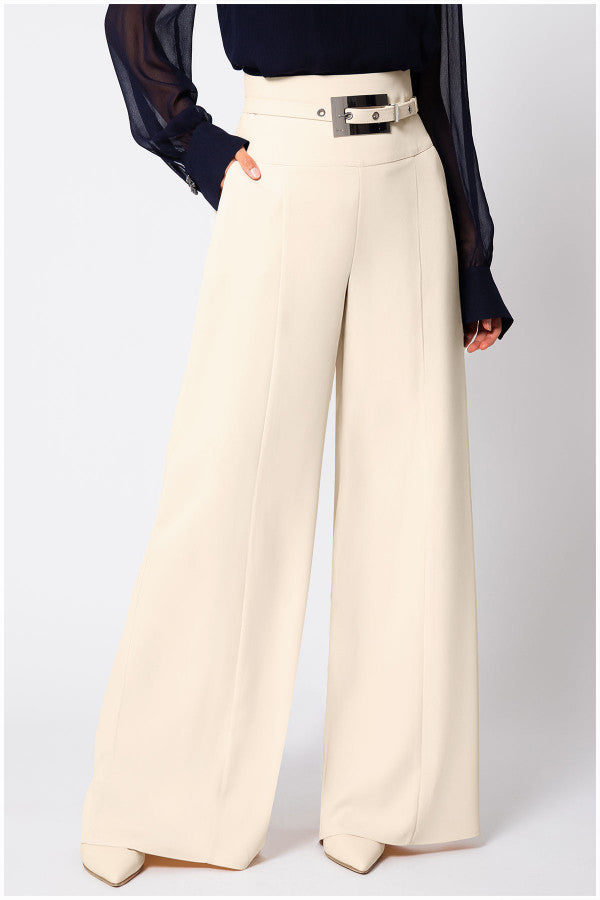
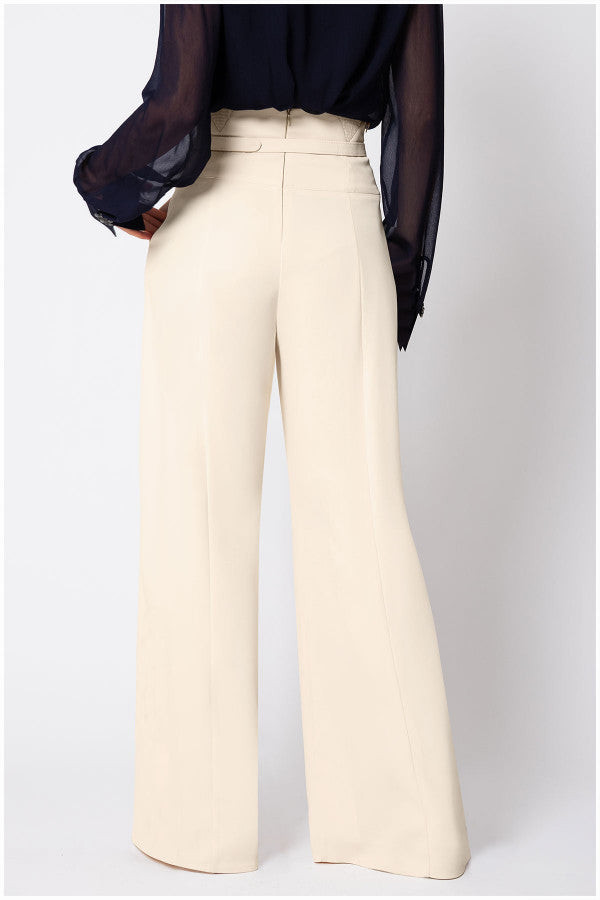
The rule that saves outfits: if a color is wrong for your face, it is not wrong for your legs. Black is expected in most offices; if black at the collar tires you, wear black trousers under the gray herringbone Nicole or a taupe top. If camel washes you out, wear ivory wide leg pants under a navy or midnight jacket. If you love red and it fights your skin, put it in a bordeaux pencil skirt and keep navy at the neck. The eye reads the collar; it forgives the hem.

The same rule runs the other way. A color that is right for your face can go anywhere: the woman who wears the red Alexa well can wear the red as a coat, a dress, or a scarf. 3 formulas that rarely fail: a column of 1 color from shoulder to hem with the collar color on top; 2 neutrals with 1 color at the collarbone; and a coat in a neutral that agrees with your face over anything at all.
Putting colors together
2 or 3 colors in an outfit, never more, and the hardware does not count. The simplest system is 1 dominant neutral, 1 secondary, and 1 accent, roughly 60, 30, and 10% of what the eye sees. Tonal dressing, 1 color family from shoulder to hem with texture doing the work, lengthens and reads expensive; high contrast, a light top against a dark bottom, defines and shortens at the join, and reads authority. Navy and black together are not a mistake when the cloths differ; camel and gray, ivory and black, brown and navy, bordeaux and navy are the neutral pairs that always agree. Red is a neutral once you own it; so are silver and bronze after dark.
8 formulas from the garments in this guide, each with the face color at the collar:
- Navy at the collar: the Olga wrap dress under the gray herringbone Nicole, black shoe. Boardroom.
- Ivory at the collar: the Agatha blazer and pants as a column, a mocha bag. Spring wedding.
- Red at the collar: the Alexa blazer over black Teodora pants and a black shell. Keynote.
- Midnight at the collar: the Lucy blazer over the Lucy sheath, 1 column of blue. December board dinner.
- Bordeaux at the collar: the Jody lace dress under the black Nicole, black shoe. Holiday party.
- Taupe at the collar: the Eva top tucked into ivory wide leg pants, a tan shoe. Low contrast, long line. Client lunch.
- Mocha at the collar: the Isidora coat over gray houndstooth trousers and a cream knit. Warm authority. First day in a new role.
- Plum at the collar: the Rebeka gown under the Selina cape, silver at the ear. Winter gala.
The color for the day
| The day | Wear near the face | The note |
|---|---|---|
| Boardroom, pitch | Navy, charcoal, ivory, mocha; 1 deep color if you want to be remembered | High contrast reads authority; low contrast reads warmth. Choose on purpose |
| Interview | Navy, charcoal, taupe, ivory | Black can read severe; navy reads trustworthy on nearly every face |
| On camera, headshots | Navy, teal, bordeaux, midnight green, mid tones in matte cloth | Pure white blows out, pure black loses its shape, fine patterns strobe |
| Wedding guest | Bordeaux, navy, teal, plum, blush, midnight green; a print on a dark ground | Never white, ivory, or cream |
| Mother of the bride or groom | Navy, plum, mocha, blush, champagne, a soft bordeaux, silver | Agree with the wedding palette; never match the bridesmaids |
| Funeral, memorial | Black, navy, charcoal, mocha, midnight green | Muted and matte; texture rather than shine |
| Holiday party | Bordeaux, midnight green, silver, bronze, red | 1 deep color or 1 metallic, the rest quiet |
| New Year, 50th birthday | Bronze, silver, anthracite, black with a bare shoulder | Metallic reads celebration; keep the jewelry to 1 metal |
The questions women ask before they invest
Which color suit looks most expensive on camera? Navy or midnight, in a matte cloth, with 1 point of contrast at the collar: an ivory blouse or a skin tone V. Black on camera loses its seams and reads as a shape; gray herringbone reads as texture; red reads as the point of the shot and belongs on a keynote, not a panel of 5.
Navy or black trousers for the office? Navy goes with more: camel, gray, ivory, bordeaux, red, and black itself. Black goes with fewer and shows lint. If you own 1 pair, navy; the Teodora and the Greta wide leg come in both.
Can a woman over 50 wear a bright blazer to the office? Yes, as the 1 bold piece in an outfit of neutrals, near a face it agrees with. The Alexa in red on a cool, clear complexion; the same jacket in navy on a soft one. 2 bold pieces in 1 outfit is the mistake, not the age.
How do I build a neutral wardrobe if I am warm toned? Camel, sand, mocha, ivory, and olive as the neutrals, navy instead of black for the dark piece, and gold hardware. The Isidora in mocha, the Natasha sand suit, the Agatha ivory blazer.
Best coat color if I buy 1? Navy for a cool or clear face, gray herringbone for a soft one, camel or mocha for a warm one. Black only if black already lives near your face and looks awake there.
Does charcoal show lint less than black? Yes, and herringbone least of all, because the pattern hides a hair. For a woman with a dog or a cat, the Nicole in herringbone gray outlasts the black by a season of looking clean.
Are brown suits back for corporate women? Mocha, a brown with red in it, is the authority brown this year and reads warmer than navy in a room. Wear it with ivory and gold near the face, and never with black, which flattens it.
How do I mix camel, navy, and black? 2 at a time, never all 3, and the darker of the 2 below the waist: camel coat over navy, navy jacket over black trousers, black coat over camel. The third color is the shoe, and it matches the piece below the waist.
What colors read modern in tailoring now? Midnight, mocha, ivory, bordeaux, and 1 clear red or teal as the single bold piece. What reads dated is a print in 3 colors, a pastel suit, and a jacket that matches the shoes exactly.
Frequently asked questions
What colors look best with gray hair? The strongest colors you own, at the collarbone: navy, charcoal, crisp ivory, bordeaux, teal, midnight green, plum. Move light gray and pale beige, the colors nearest the hair, to the trousers and skirt. Gray hair softens and cools the picture, but it does not change your undertone, so a warm skin under gray hair still wears mocha and a warm red near the face.
Navy or black near the face? Navy, for most women over 40. Black is harsh beside soft, warm, or low contrast coloring and shows every shadow; it belongs to cool, clear, high contrast coloring. If your office expects black, wear it below the waist and put navy, charcoal, or gray herringbone at the collar.
How do I find my undertone at home? Hold pure white and then ivory at your throat in daylight. If ivory rests the face and white tires it, you lean warm or soft. If white sharpens you, you lean cool and clear. Filters and phone photos in bathroom light mislead; a window does not.
What colors suit olive skin? Muted, slightly cool colors: deep teal, midnight green, soft charcoal, bordeaux, dusty rose, ivory rather than white. Strong orange, yellow camel, and clear turquoise can turn olive skin greenish near the face; wear them below the waist or as a bag.
What if a color I love is wrong for my face? Wear it below the waist, as a skirt, trousers, shoes, or a bag, and keep a color that agrees with your face at the collar. The eye reads the collarbone and forgives the hem.
Do I need a professional color analysis? If you want a card to carry, an in person draping in daylight is still the gold standard, and it is better than any app. If you want to dress well tomorrow, the collar test and the rule of the wrong neutral will get you most of the way.
The Fitting Room at Home
Order the 2 sizes that bracket your shoulder. Run the 6 tests in your own mirror, in the shoes and the blazer you will wear. Keep the one that passes and send the other back within 30 days, self serve, no questions. If you would rather be told, send your 3 numbers, shoulder, bust, and hip, and the day it is for, to connect@lunafashionhouse.com; a person who knows the cut replies within 1 business day with the size and the piece.
Put the right color at the collarbone and the wrong one at the hem, and you can wear more of the wardrobe than any palette allows. See the colors on the garments in Dresses, Blazers, and Winter Coats, and hold each one at your own throat in your own daylight; you have 30 days.