
The Best Colors for Women Over 50: A Field Guide to Dressing with Gray and Silver Hair

Navy, ivory and charcoal are the neutrals that flatter gray and silver hair, and one gem tone or true red worn near the face finishes the palette. The Clara Wool Trench Coat in Navy Blue at $910 is the navy to start with, a double breasted belted coat with a black faux fur collar, and the Lucy Draped Blouse in Ivory at $560 brings ivory to the neckline with a draped cowl and full sleeves.
For the red, the Lucy Wool Coat with Faux Fur Collar in Red at $910 is a red wool coat with a tonal red faux fur collar and a full skirt that ends near the knee. See every coat in winter coats, more neckline color in blouses and more structure in blazers. Every piece is made in our Pozarevac atelier, US orders ship free and arrive in 2 to 5 days, and each order has 30 days for a return with no questions asked.

The best colors for women over 50 with gray or silver hair are navy, ivory, and charcoal as neutrals, with clear, deep accents of teal, sapphire, emerald, bordeaux, amethyst, and true red worn within a foot of the face. Silver hair changes your contrast, so the beige that used to be kind can now look tired.
Shop the pieces in this story: Winter Coats, Blouses, and Blazers. Complete size runs are listed first.
Gray and silver hair is one of the most flattering backdrops a wardrobe can have. It reads as expensive, it pairs with both cool and clear colors, and it lets you wear shades that overwhelm darker hair. The work is learning to read your own coloring and to place color where it does the most. Follow the six steps in order; each one takes a minute in daylight.
Step 1: Identify your hair’s actual tone
Gray is not one color. Most women fall into one of three groups, and the group sets the temperature of everything that follows. Cool silver and white hair has a bright, clean cast and pairs best with cool, clear colors. Soft or warm gray carries a faint beige or yellow undertone and is flattered by slightly softened versions of the same shades. Salt-and-pepper, where dark hair still mixes with the gray, keeps higher natural contrast and can carry deeper, more saturated color than fully silver hair.
To check, hold a sheet of pure white paper next to your hair in daylight. If the hair looks crisp and almost blue-white, you are cool. If it looks softer and faintly warm against the paper, you are warm gray. This single observation steers every choice below.
Step 2: Find your contrast level
The second variable is contrast, the difference in lightness between your hair and your skin. When your hair was dark, you most likely had high contrast, and high contrast carries strong, deep color easily. As hair lightens to silver or white, contrast usually falls, and the very dark colors that once framed the face begin to overpower it. That is why so many women say black “stopped working.” It did not stop working; the contrast it relied on faded.
Stand at a window and notice whether your hair and skin read as close in lightness (low contrast) or clearly different (high contrast). Low contrast is flattered by soft-to-medium color and by a lighter neckline under anything dark. High contrast, common in salt-and-pepper, can still wear deep saturated color straight against the face.
Step 3: Choose your power neutrals
Every wardrobe needs neutrals that do the quiet daily work, and gray hair changes which ones flatter. Navy is the single most reliable neutral for silver and gray hair. It gives the structure of dark dressing without the harshness of black against a lighter face, and it is warmer in photographs. If you buy one dark piece this year, make it navy, and make it the piece you wear most: the coat. The Clara Wool Trench Coat in Navy Blue is cut from 87 percent long-fiber wool and 13 percent nylon at 420 grams per square meter, double-breasted, with a tie belt, a black faux-fur collar that frames the face, and a full Bemberg lining, and it finishes well below the knee. Against silver hair the navy reads as depth rather than weight, and the collar puts a soft dark line exactly where a scarf would go. For the layer underneath, a Lola Business Blouse in Navy carries the same navy to the collarbone.

Ivory and soft white are the neutrals that brighten a silver-haired face the way black no longer can. The Lucy Draped Blouse in Ivory is the piece to start with: 100 percent refined technical satin, a softly draped cowl neckline that puts light directly under the chin, full sheer sleeves gathered into buttoned cuffs, and small pearl-inspired accents at the shoulders and cuffs. Worn under a navy or charcoal jacket it does more for the face than any necklace. Charcoal and soft pewter give you the depth of black with far less weight near the face, and they echo the hair rather than fighting it.

This is not a ban on black. Black remains a strong evening color, worn slightly away from the face or broken with a lighter neckline. It moves from default to deliberate. The neutral foundation pieces that build a palette are gathered in The Essentials.
Step 4: Choose your color accents
Here is where gray hair becomes an advantage. Silver and gray act as a clean neutral frame, which means clear, saturated colors that overwhelm darker hair look their best against it. The most reliable family is the gem tones: deep teal, sapphire, emerald, bordeaux, and amethyst all read as rich and intended against silver. For fall and winter, choose the Jody Tailored Lace Blazer in Midnight Green: a structured, lined blazer in botanical fiber lace and knit in deep forest green, with a wide lapel collar, a buttoned placket, and cuffs all worked in lace, and a faint shimmer in the cloth that catches evening light. Green this deep against silver hair reads as intended from across a room, and the lace at the collar keeps the color exactly where Step 5 wants it.

True, clear reds, neither orange-warm nor brown-dusty, are exceptional on gray hair and read as confident rather than loud. Bordeaux is the quieter cousin. The Jody Lace Blouse in Bordeaux is a sleeveless blouse with a round neck and a rose-pattern lace bodice in deep wine, cut to sit under a blazer or a cardigan so that the wine tone lives at the collarbone all day. Cool pinks, soft blues, and clear greens flatter cool silver; warm gray hair is better served by slightly softened versions of the same colors. Approach muddy, dusty, or yellow-heavy tones with care: mustard, khaki, and beige worn near the face blur into gray rather than contrasting with it.

Step 5: Place color where it does the most work
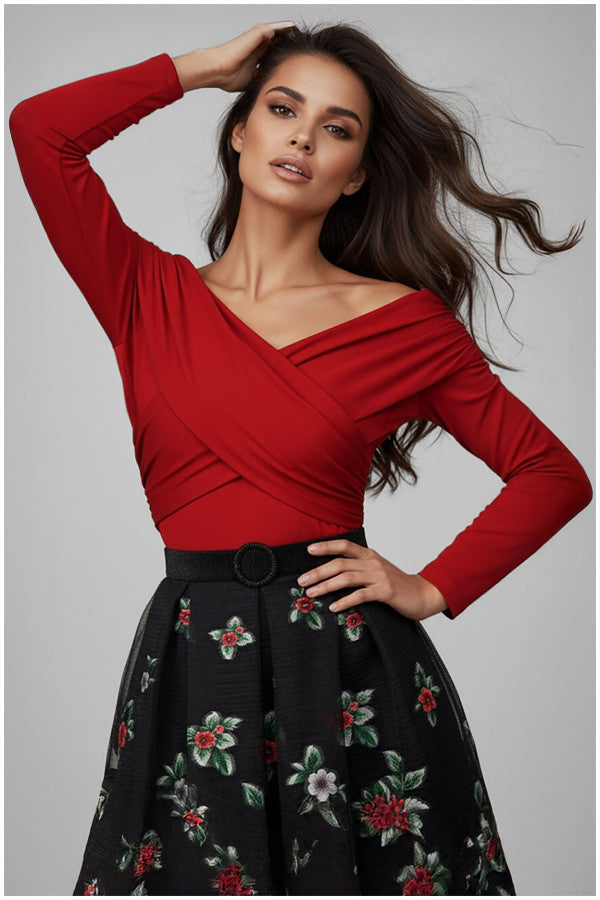
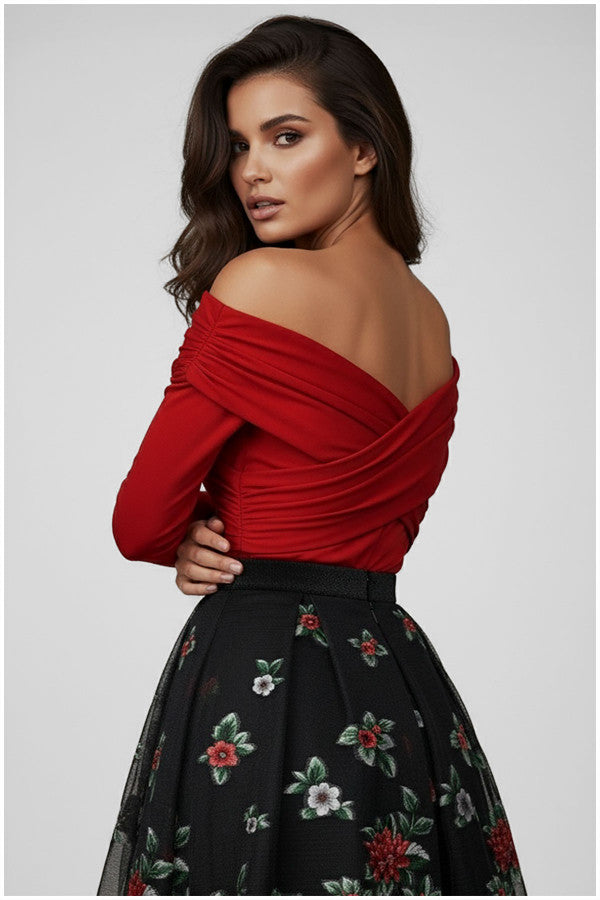
Color matters most within roughly a foot of your face, because that is where it either lifts your complexion or drains it. The rule is simple: your best colors go at the neckline, and neutrals carry the rest. If you love a color that is no longer ideal near your face, a softer beige for instance, wear it as a skirt or a pant and keep navy, ivory, or a gem tone at the collar. For the day you want presence, choose the Donna Off-Shoulder Top in Scarlet Red: a soft botanical knit that crosses at the front, sits off both shoulders, and runs to a long fitted sleeve. It puts true red on the collarbone and nowhere else, which is the whole method in one garment.

The blazer is the other place color earns its keep near the face, because the lapel frames the jaw. Choose the Alexa Tailored Blazer in Red for the meeting, the lunch, or the wedding where you would rather be remembered than blend in: a fitted, fully lined blazer in saturated red with a notch lapel, four covered buttons, flap pockets, and a precise shoulder. Over an ivory blouse and navy pants it is the entire palette of this guide in three pieces. For seasonal color direction, the Fall Bordeaux Lace Collection and the Fall Midnight Green Lace edit are built around exactly the deep tones that flatter silver.

Step 6: Test in daylight before you commit
Store lighting lies. Fluorescent and warm retail bulbs both distort color against silver hair, which is why a shade looks perfect in the fitting room and wrong at home. Before you commit to a color for an important event, hold the piece against your face in natural daylight near a window. Watch whether your skin brightens or grays, and trust that reading over the showroom mirror. The colors that pass the daylight test are the ones to build around. This is also why we would rather you try a piece at home than in a store: the light in your own bedroom at 9 a.m. is the only light that tells the truth.
The coat question: navy, camel, black, or red with gray hair
Your coat is the color you wear most often and closest to your face, so choose its color first. Every fall, women with gray hair ask whether their one coat should be camel, black, navy, or red. For most women with silver hair the answer is navy. Navy carries the authority of a dark coat and is kinder to silver hair than black.
- We recommend the Clara Wool Trench Coat in Navy Blue ($910) first. It is a very dark navy wool that reaches mid calf.
- Red is the second coat, the one you buy after the navy has earned its hook in the hall. We make 2 in true red, each with a red faux fur collar. The Lucy Wool Coat in Red ($910) is fitted at the waist with a full skirt to the knee. The Selina Wool Coat with Red Faux Fur Collar ($825) is straighter and a little longer.
- If you would rather echo the hair than contrast with it, look at the Nicole Wool Coat in Herringbone Gray ($825). Its herringbone mixes light gray with charcoal. The light thread picks up the silver, and the charcoal keeps the coat from fading into it.
- Black works, but only with a lighter scarf or collar between it and the face. Our Nicole in Solid Black ($825) and Lucy in Black ($910) both have black collars, so add an ivory scarf.
- Ivory puts light at the face. The Linea Belted Midi Coat in Ivory ($770) carries it from the collar to mid calf.
- Camel with a yellow undertone blurs into warm gray at the collar. Wear it as a skirt or pants, as Step 5 suggests, and keep the coat navy.
Before you order: fit, sizing, and returns
The blouses and blazers here are cut to a tailored or true-to-size fit, closer to the body than most American labels, and sized 2 to 14 across the range (the Alexa blazer runs from 0 to 16). The Clara coat is cut to go over a blazer, so order your usual size rather than sizing up. Measure bust, natural waist, and hip and compare them to the size chart on the product page. If you sit between two sizes, order both and keep the one that fits: returns are 30 days, no questions asked, with return shipping covered, and shipping within the United States is complimentary. Try each piece at a window, not in a hallway, and do Step 6 before you decide.
The practical case
The emotional case is that you will look in the mirror and see the color in your face come back. The practical case is that a palette built this way is small. Three neutrals, four accents, and every piece works with every other piece, so you buy fewer things and wear each one more. The blouses, tops, and blazers in this guide are machine washable on a gentle cycle, air dried, and steamed on low, which means the ivory blouse you wear twice a week does not live at the dry cleaner. The Clara coat is dry clean only, once a season, and brushed and hung on a wide hanger between wearings. Every piece is cut and finished in one atelier in Pozarevac, Serbia, in small runs with a few of each size.
A starter palette to build from
If you would rather begin with a working palette than a theory, here is a reliable one for most gray and silver hair. Build the foundation from three neutrals: navy, ivory, and charcoal. Add three accents from the gem family, chosen from deep teal, bordeaux, sapphire, emerald, and amethyst, and one true clear red for the days you want presence. That is seven colors that combine endlessly and all flatter silver. Cool-silver hair can push the accents toward the cooler, clearer end; warm-gray hair should soften them a touch. From there, every new piece either fits the palette or earns a deliberate exception. The Luna Signature Collection is a useful place to see these tones in tailored pieces.
A note on metals, makeup, and scarves
Two finishing details change how a color reads against silver hair. The first is metal: silver, white gold, and platinum echo cool gray hair, while warm gray can also carry soft gold. Let your hair’s temperature from Step 1 decide. The second is the small amount of color closest to your face. A defined lip often does more to lift a complexion against silver hair than any garment, because it restores the warmth that gray can flatten. And a scarf is the least expensive way to test a new color near the face before committing to a whole garment: drape it, check it in daylight, and you will know in seconds whether the color belongs in your palette. The scarves collection covers the palette above.
Adjusting the palette by season
The core palette holds all year; the emphasis shifts. In fall and winter, lean into the deepest gem tones and the true reds, which read rich in low light and against heavier cloth, and which the Fall Midnight Green Lace and Fall Bordeaux Lace edits are built for. In spring and summer, keep the same colors but reach for their lighter, clearer versions and let ivory do more of the work, because strong saturation can feel heavy in bright daylight. The discipline is the same in every season: flattering color at the face, neutrals carrying the rest, and a daylight check before anything important.
What about prints and pattern?
Prints follow the same logic as solids, with one addition: the ground of the print matters as much as the figures on it. A floral on an ivory or navy ground reads cleanly against silver hair; the same floral on a muddy or yellow-heavy ground blurs the way a muddy solid does. Scale is the second consideration. A medium-scale print sits comfortably on a mature frame, where very small busy prints can read as fussy and very large ones can overwhelm. Polka dots, quiet stripes, and restrained florals are all friendly to gray hair when their colors come from your range. When in doubt, treat the dominant color of the print as the color you are wearing and judge it by the daylight test.
The mistakes that wash out a silver-haired complexion
A handful of habits undo otherwise good choices. The first is defaulting to black at the neckline out of habit, when navy, charcoal, or a gem tone would lift the face instead of weighing it down. The second is reaching for warm, dusty neutrals (taupe, camel, mushroom) directly against the face, where they gray the complexion rather than warm it; wear them below the waist instead. The third is judging color under store lighting and skipping the daylight check. The fourth is wearing too little color anywhere, which leaves a silver-haired woman looking monochrome; one clear color near the face keeps the whole look alive. None of these is hard to fix once you can see it.
A one-week way to learn your palette
If the theory feels abstract, learn it by doing. For one week, each morning hold two or three pieces to your face in daylight before you dress, one you suspect flatters you and one you are unsure of, and notice which makes your skin look brighter and which makes it look gray. Keep a short note on your phone of the winners. By the end of the week you will have an evidence-based shortlist of your best colors, drawn from your own wardrobe and your own face, that no general rule can give you. The colors that keep winning are the ones to build around and to wear at the neckline; the ones that keep losing move below the waist or leave. One week of attention replaces years of guessing, and it costs nothing but a mirror and a window.
From there the practice becomes automatic. You will see, without holding anything up, which side of the store is yours, which scarf someone gives you will actually get worn, and which trend color to try. Silver hair does not shrink your palette. It expands it: colors that overwhelm dark hair (clear emerald, true red, cool sapphire) look their best against a clean silver frame. The mirror stops being a negotiation and becomes a confirmation.
Frequently asked questions
What colors look best on women over 50 with gray hair?
Navy, ivory, and charcoal as the neutrals, and clear gem tones such as deep teal, sapphire, emerald, bordeaux, and amethyst as the accents, along with true clear red. These read rich against silver, where black can look heavy and beige can look tired. Put the accent within a foot of the face and let the neutrals carry the rest; a navy coat with an ivory blouse is the simplest version of the whole palette.
Can I still wear black with silver or white hair?
Yes, deliberately. Black works best worn slightly away from the face or broken with a lighter neckline, an ivory blouse, or a scarf in a gem tone. Directly against the face it can drain a lighter complexion as contrast falls. Keep black for evening, for the lower half of the body, and for pieces with texture, and let navy or charcoal take its place at the collar during the day.
What colors should I avoid with gray hair?
Muddy, dusty, or yellow-heavy tones such as mustard, khaki, and warm beige worn near the face, which blur into gray rather than contrasting with it. Camel with a strong yellow undertone belongs in the same group. None of these is forbidden; they simply move below the waist, as a skirt or a pant, with a flattering color at the neckline to frame the face.
How do I know if my gray hair is cool or warm?
Hold a sheet of pure white paper against your hair in daylight. If the hair looks crisp and almost blue-white, it is cool silver and takes clear, cool color. If it looks softer and faintly warm against the paper, it is warm gray and is flattered by slightly softened versions of the same colors. Check once at a window; store lighting will give you the wrong answer.
Does salt-and-pepper hair follow the same rules?
Mostly. Salt-and-pepper keeps higher natural contrast than fully silver hair, so it can carry deeper, more saturated color directly against the face, including black at the neckline, for longer. The same neutrals apply. As the gray increases and the contrast falls, move the darkest colors a step away from the face and let navy and the gem tones do the framing.
Where should I wear my best colors?
Within about a foot of your face: at the neckline, the collar, the lapel of a blazer, or in a scarf. Let neutrals carry the rest of the outfit. Colors that are no longer ideal near the face move to a skirt or a pant. An off-shoulder top in true red, or a lace blazer in deep green, puts the color exactly where it lifts the complexion and nowhere it does not.
What color coat should I buy with gray hair?
Navy, if you are buying one. It keeps the authority of a dark coat and gives a silver-haired face its color back, where black needs a lighter scarf between it and the skin and yellow-toned camel blurs into warm gray at the collar. The Clara Wool Trench Coat in Navy Blue, with its black faux-fur collar and full lining, is the one we recommend first. Red is a wonderful second coat once the navy is hanging in the hall.
What to do next
Do Step 1 and Step 2 at a window this morning. Then choose the one piece that puts your best color at the face: the Clara in navy if the coat is the gap, the Lucy blouse in ivory if you need light under the chin, the Jody blazer in green or the Alexa in red if you want to be remembered. Order your size and the one beside it if you are unsure, try both in daylight, and keep the one that makes your skin brighter. The pieces that build this palette are in The Essentials and the blazers collection.
Continue reading
Read How to Dress When Your Body Starts Changing Shape, Wearing Lace Now: Without Looking Dated, and Christmas Party Outfit for Women Over 50.
One navy blazer to anchor the palette
The Lucy Tailored Jacquard Blazer in Midnight Blue at $680 is a navy cotton blend jacquard with a subtle woven texture, a decorative floral clasp and a waist that is cinched in. Wear it over the ivory Lucy blouse and the navy sits below the face while the ivory sits right under it.
More questions about color and silver hair
Which Luna piece is the easiest first buy for silver hair?
The Lucy Draped Blouse in Ivory at $560 is the easiest first buy, since its ivory cowl neckline puts light under the chin, and the Lucy Tailored Jacquard Blazer in Midnight Blue at $680 is the navy layer to wear over it.
Can I return a color that does not suit my hair?
Yes, every Luna order has 30 days for a return with no questions asked, and US orders ship free and arrive in 2 to 5 days, so you can test a color in daylight at home.