
Dresses With Pockets and Other Small Freedoms in Tailoring

Dresses With Pockets and Other Small Freedoms in Tailoring
Women love dresses with pockets because a pocket is a small freedom: somewhere to put a phone, a key, a badge, and your hands. A well cut pocket does not change the line of a dress. A well cut wrap adjusts to the body you have today, a belt that moves lets you decide where your waist is, a sleeve cut with ease lets you reach for the coffee, and a dress you can wash at home gives you back the Saturday you would have spent at the cleaner.
This is a guide to those freedoms, the ones you notice on the second wear and stop being able to live without. Every pocket, belt, and wrap below is one you can see in the photographs or read in the catalog, and every non-coat piece goes through your own washing machine.
Shop the pieces in this story: Dresses, Pants, and Blazers. Complete size runs are listed first.
Why women love dresses with pockets
For most of the history of womenswear, pockets were something men had. Women carried a separate pocket tied under the skirt, hard to reach and easy to lose, and then a bag. The pocket became a symbol of independence for a reason: it is the difference between being handed things and carrying them yourself.
The modern version is smaller and just as real. A phone and a card case in a pocket mean a walk to lunch without a bag. A badge in a pocket means one less thing in your hand at the door. And in a room where you do not yet know anyone, a pocket gives your hands somewhere to be, which changes how you stand.
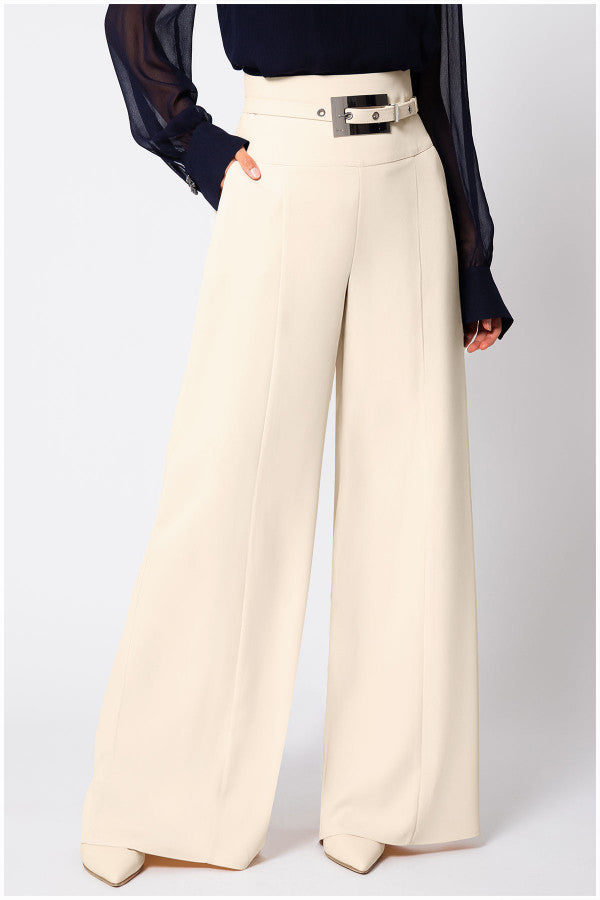
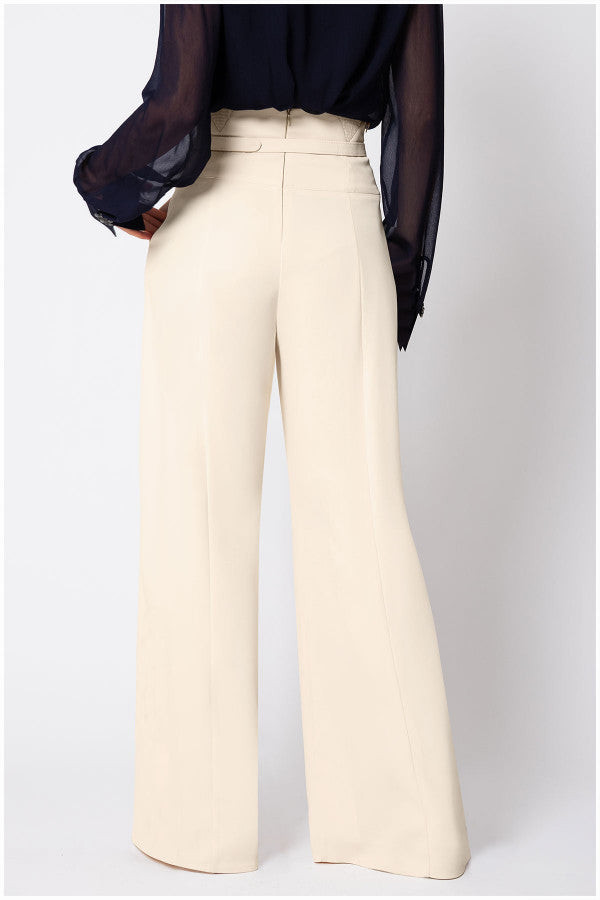
The Agatha high-waisted wide-leg pants in ivory show what a pocket looks like when it is cut properly. In the photograph the model stands with one hand in the side pocket, and the column of the leg does not break: the waistband stays flat, the crease runs straight to the floor, and nothing pulls at the hip. The pants are fully lined, close with a back zipper, and come with an optional self-belt in the same ivory.

What a pocket does to a silhouette when it is cut well
A pocket is a piece of engineering. The opening sits below the hip bone so a hand goes in without lifting the shoulder. The bag inside is cut from a thin, smooth lining so it does not print through the shell. The opening is reinforced so it does not stretch, and the whole thing lies flat when empty, which is most of the time. Get all four right and the pocket disappears into the line. Get one wrong and it gapes.
The same pants in black, the Agatha high-waisted wide-leg pants in black, are photographed the same way, a hand resting in the side pocket and the waistband flat. Black hides more than ivory, so the ivory pair is the proof.
A flap pocket does a second job: it draws a horizontal line at the hip. On a long single-color jacket that line stops the eye from sliding straight down, and it reads as tailoring rather than utility. The Agatha pearl detail blazer in ivory has flap pockets with a row of small pearls stitched along each flap, three pearl buttons, notched lapels, and a line that traces the natural waist. In the photograph it is worn over the matching ivory pants, and the flaps sit exactly where the jacket begins to skim the hip.

On a sheath dress, the flap works even harder because a sheath is one unbroken column from collar to knee. The Lucy navy illusion sleeve sheath dress has a shirt collar with a clasp, sheer mesh across the yoke and down the long sleeves, a center front seam, and pocket flaps at the hip, which the catalog describes as a tailoring detail. In the photograph those two flaps mark the hip and give the eye a place to rest before the skirt narrows to the knee.

Coats with pockets: where your hands go in January
A coat pocket is half the reason you reach for one coat and not another on a cold morning. The Nicole wool wrap coat in black is a black wool wrap coat with a wide collar, a double-breasted front, a self-belt with a buckle, patch pockets, and a midi skirt that flares from the waist. In the photograph the model stands with both hands in the pockets and the belt still sits flat. Coats are dry clean only, and this one is built to be worn for years between cleanings.

The Linea belted midi coat in ivory takes the flap pocket to a long midi coat: ivory textured cloth, a notch collar, three buttons, a belt with a black buckle, and flap pockets at the hip, for the woman who wants ivory in winter and somewhere to put her hands.
A wrap that adjusts
The second freedom is a closure you control. A true wrap dress closes by wrapping the front across the body and tying at the waist, so the waist is set by you and not by the pattern: a little looser on a day you had lunch out, a little tighter on a day you want a line. A fixed front that only looks wrapped gives you none of that.
The Olga wrap dress in navy is a true wrap in solid navy with a notched collar, short sleeves, a belt with a gold buckle, and a row of buttons down the side of the wrap skirt to the knee. The catalog calls it an adjustable wrap closure with a self-tie belt, and says to take the smaller size between sizes for a defined closure. It is the dress women buy for an interview and then wear every week.

A belt that moves
A belt sewn into a garment tells you where your waist is. A belt that comes off lets you decide. The Barbara tailored blazer in black is a black blazer with notched lapels, four buttons, and flap pockets finished with a fine line of red piping, photographed over a black satin shirt. The catalog adds a self-tie belt cut from the same twill, so the blazer can be worn belted, loose, or open with the belt removed. Three jackets from one.

The Agatha pants do the same at the waist: the self-belt is optional, so the wide leg is worn belted for definition or without for an uninterrupted line from waist to floor.
Sleeves that let you reach and a waist that lets you eat
A sleeve is a freedom when it is cut for the arm you use rather than the arm that stands still for a photograph. The Jody lace cocktail dress in bordeaux has short lace sleeves that the catalog describes as giving coverage without restricting movement, the whole point of a sleeve on a dress you will dance in. On the Lucy sheath, the mesh sleeves are cut close to the arm and finish at the wrist.
A waist is a freedom when it forgives a long flight or a long dinner. The Teodora travel pants in black are black tailored trousers with a pull-on elastic waist and a straight leg that narrows to the ankle; in the photograph they read as ordinary tailored pants, which is the trick. The catalog says to size up if you prefer a looser drape.

Machine washable: the freedom nobody photographs
Every Luna dress, blazer, blouse, skirt, and pair of pants is machine washable on a gentle cycle, then air dried and steamed or ironed on low. Coats are dry clean only. That rule is the same for every non-coat piece, so you never have to check a label or budget a trip to the cleaner for a Tuesday dress.
The freedom is time and control. A working woman who sends out eight to 10 pieces a month spends, on a modeled estimate from current US price bands, close to $1,500 a year and about 12 hours in the queue. Washing at home means you choose the detergent, the water, and the day. Empty the pockets first.
Fit, sizing, and returns
Pockets do not change the size you take, because they are cut into the pattern. The Agatha pants and blazer run slightly generous, and the product pages say to take the smaller size between sizes; the Barbara blazer and the Olga dress run true to size. If you are unsure, order two sizes: every order ships from California and can be returned within 30 days, no questions asked.
If you are building from the beginning, the 3 3 3 rule for clothes pairs well with pieces that carry their own freedoms, and the fresh start wardrobe explains why the coat comes first.
Frequently asked questions
Why do women want pockets in dresses?
Because a pocket is somewhere to put your phone, your keys, and your hands. For most of the history of womenswear, pockets were left out of dresses to keep the line slim, and women carried everything in a bag. A dress with pockets means a short errand without a bag, a badge on the body, and a place to rest your hands in a room full of strangers. The pleasure is autonomy, not novelty.
Do pockets make a dress look bulky?
Only when they are cut badly. A pocket that adds bulk was set too high, bagged in a stiff fabric, or left without enough ease so the opening gapes. A well cut side seam pocket sits below the hip bone, is bagged in a thin lining, and lies flat when empty, so the line of the dress does not change. A flap set at the hip can even help, because it gives the eye a horizontal line to rest on.
Which Luna pieces have pockets?
The Agatha high-waisted wide-leg pants in ivory and in black have side pockets you can see in the photographs. The Agatha pearl detail blazer in ivory has flap pockets with pearls stitched to the flaps. The Lucy navy illusion sleeve sheath dress has pocket flaps at the hip as a tailoring detail. Among the coats, the Nicole wool wrap coat in black has patch pockets.
Does a wrap dress really fit every body?
A true wrap dress, one that closes by wrapping and tying rather than a fixed front that only looks wrapped, fits a wider range of bodies than almost any other cut because the waist is set by you, not by the pattern. The Olga wrap dress in navy is a true wrap with a self-tie belt. If you are between sizes, take the smaller for a defined closure; the tie gives you the rest.
Are Luna dresses and pants machine washable?
Yes. Every Luna dress, blazer, blouse, skirt, and pair of pants is machine washable on a gentle cycle, air dried, and steamed or ironed on low. Coats are the one exception and are dry clean only. Pockets and linings go through the wash with the garment, so there is nothing to send out and nothing to wait for. Empty the pockets first.
What to do next
Choose one freedom you keep wishing your clothes had, and buy that first: the pants with the pocket that lies flat, the dress that ties where you say, the blazer whose belt comes off. Then wear it on a Tuesday. The dresses in this story are in the dresses collection and the pants in the pants collection, complete size runs first.